Java集合学习之HashSet

简介

在一般的使用中,HashSet经常用于数据的去重,例如我们有一个List,这个List里面有一些重复的数据,于是我们便可以这样操作

1
2
3
4
5
6
7
List<String> list = new ArrayList<>();
list.add("a");
list.add("b");
list.add("c");
list.add("a");
Set<String> set =new HashSet<>();
set.addAll(list);

此时,在Set里面,只会有一个a元素。

底层

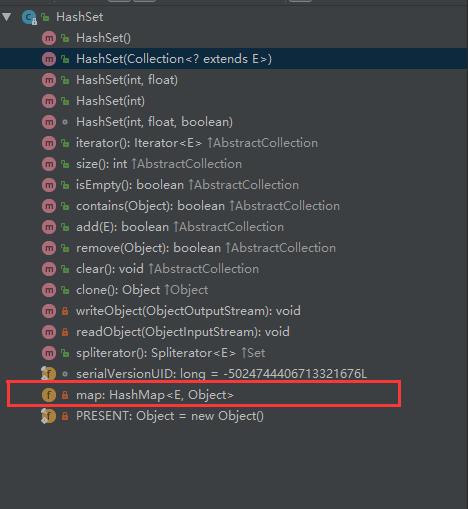
其实HashSet的底层是一个HashMapHashSet的去重使用了HashMapKey
如图所示:

1
2
3
4
5
6
7
8
9
10
11
12
13
14
15
16
/**
* Adds the specified element to this set if it is not already present.
* More formally, adds the specified element <tt>e</tt> to this set if
* this set contains no element <tt>e2</tt> such that
* <tt>(e==null&nbsp;?&nbsp;e2==null&nbsp;:&nbsp;e.equals(e2))</tt>.
* If this set already contains the element, the call leaves the set
* unchanged and returns <tt>false</tt>.
*
* @param e element to be added to this set
* @return <tt>true</tt> if this set did not already contain the specified
* element
*/
public boolean add(E e) {
return map.put(e, PRESENT)==null;
}

HashSet的add方法是向一个map里面放入元素,而HashMap则是不允许键重复,所以就可以确保在HashMap上的键都是不重复的。

HashMap是如何确保每一个对象都只有一个的呢?

首先当调用HashSet的add方法的时候,其实是调用HashMap的put方法,

1
2
3
4
5
6
7
8
9
10
11
12
13
14
15
/**
* Associates the specified value with the specified key in this map.
* If the map previously contained a mapping for the key, the old
* value is replaced.
*
* @param key key with which the specified value is to be associated
* @param value value to be associated with the specified key
* @return the previous value associated with <tt>key</tt>, or
* <tt>null</tt> if there was no mapping for <tt>key</tt>.
* (A <tt>null</tt> return can also indicate that the map
* previously associated <tt>null</tt> with <tt>key</tt>.)
*/
public V put(K key, V value) {
return putVal(hash(key), key, value, false, true);
}

这个方法无非是先将这个key进行hash,然后再调用putVal方法进行保存,

1
2
3
4
5
6
7
8
9
10
11
12
13
14
15
16
17
18
19
20
21
22
23
24
25
26
27
28
29
30
31
32
33
34
35
36
37
38
39
40
41
42
final V putVal(int hash, K key, V value, boolean onlyIfAbsent,
boolean evict) {
Node<K,V>[] tab; Node<K,V> p; int n, i;
if ((tab = table) == null || (n = tab.length) == 0)
n = (tab = resize()).length;
if ((p = tab[i = (n - 1) & hash]) == null)
tab[i] = newNode(hash, key, value, null);
else {
Node<K,V> e; K k;
if (p.hash == hash &&
((k = p.key) == key || (key != null && key.equals(k))))
e = p;
else if (p instanceof TreeNode)
e = ((TreeNode<K,V>)p).putTreeVal(this, tab, hash, key, value);
else {
for (int binCount = 0; ; ++binCount) {
if ((e = p.next) == null) {
p.next = newNode(hash, key, value, null);
if (binCount >= TREEIFY_THRESHOLD - 1) // -1 for 1st
treeifyBin(tab, hash);
break;
}
if (e.hash == hash &&
((k = e.key) == key || (key != null && key.equals(k))))
break;
p = e;
}
}
if (e != null) { // existing mapping for key
V oldValue = e.value;
if (!onlyIfAbsent || oldValue == null)
e.value = value;
afterNodeAccess(e);
return oldValue;
}
}
++modCount;
if (++size > threshold)
resize();
afterNodeInsertion(evict);
return null;
}

这个是HashMap的底层方法,当首次传入值的时候,

if ((tab = table) == null || (n = tab.length) == 0){
n = (tab = resize()).length;}

如果table未空就进行初始化,如果不为空则执行下面的代码

1
2
3
4
5
6
7
8
9
10
11
12
13
14
15
16
17
18
19
20
Node<K,V> e; K k;
if (p.hash == hash &&
((k = p.key) == key || (key != null && key.equals(k))))
e = p;
else if (p instanceof TreeNode)
e = ((TreeNode<K,V>)p).putTreeVal(this, tab, hash, key, value);
else {
for (int binCount = 0; ; ++binCount) {
if ((e = p.next) == null) {
p.next = newNode(hash, key, value, null);
if (binCount >= TREEIFY_THRESHOLD - 1) // -1 for 1st
treeifyBin(tab, hash);
break;
}
if (e.hash == hash &&
((k = e.key) == key || (key != null && key.equals(k))))
break;
p = e;
}
}

在HashMap里面,有一个数组table存放着所有的key,而 HashMap 定位下标的方式就是通过(n - 1) & hash

当HashMap发现该下标的值是null,就会直接将入参的keyvalue疯转成一个Node保存进去,如果发现不是null,则HashMap认为发生了HashMap碰撞,于时进行如下判断:

如果新传入的一个key在HashMap中已经存在,则HashMap会直接将旧的key的value替换掉。否则就会进行新增
HashMap在判断一个key是否相等会采取以下措施:

如果两个Key的hash不同,则HashMap直接会判断key不等

  1. Key和hash完全相同

    第一次传入key=a,Hash值是1,value是100;
    第二次传入key=a,Hash值是1,value是101;

此时hashMap会认为新传入的key已经存在,所以会将旧的value替换为新的value

产生Hash碰撞,也就是两个key的hash都是一样的,那么就会通过key是否相同或者equals方法判断对象是否相等了
2. Key不同,hash相同

HashMap会判断传入的key、以及key的hash值,如果相等则认为该键以相等,例如:

第一次传入key:a,Hash值是1;
第二次传入key:b,Hash值是1;

这个时候由于key不同,hashMap还会通过equals继续判断。

  1. 由于第二次传入的key是b,但是他们的Key并不相等,此时HashMap就会调用他们的equals方法,如果通过equals方法判断的是相同对象,则也会认为是同一个key。

此时如果判断新增的key确实不存在就会在当前的table位置通过链表地址方法辛增一个key了。

那么到这里就可以看到,其实HashSet就是完全的利用了HashMap的键的特性来进行去重。

Iterator方法

1
2
3
4
5
6
7
8
9
10
/**
* Returns an iterator over the elements in this set. The elements
* are returned in no particular order.
*
* @return an Iterator over the elements in this set
* @see ConcurrentModificationException
*/
public Iterator<E> iterator() {
return map.keySet().iterator();
}

其实都是利用了hashMap的一些方法来实现

线程不安全

由于HshMap是非线程安全的,自然HashSet也不是一个线程安全的。测试代码如下:

1
2
3
4
5
6
7
8
9
10
11
12
13
14
15
16
17
18
19
20
21
22
23
24
25
26
27
28
29
public class HashSetTest implements Runnable{
Set<Integer> set =new HashSet<Integer>();
public void run() {
for(int i=0 ;i<10000;i++){
set.add(i);
}
}
}
public class HashSetTestMain {
public static void main(String[] args) throws InterruptedException {
HashSetTest hashSetTest =new HashSetTest();
Thread t1 = new Thread(hashSetTest);
Thread t2 = new Thread(hashSetTest);
t1.start();
t2.start();
t1.join();
t2.join();
System.out.println(hashSetTest.set.size());
Set<Integer> set =new HashSet<Integer>();
for(Integer i :hashSetTest.set){
if(set.contains(i)){
System.out.println(i);
}else{
set.add(i);
}
}
}
}

可以看到打印出来的结果会多于10000,这是因为在上面也说到过的,HashMap在判断一个key是否相同以及后续新增节点的时候并非是一个原子性的,所以就有可能会导致t1线程刚好判断10不在hashMap中,准备新增一个节点为10。结果此时t1被挂起,t2执行,但是t2也判断了10不在hashMap中,也准备新增,那么此时就会出现新增了两个一摸一样的Key。这样就会导致Set集合中出现了重复的数据。

作者

Somersames

发布于

2019-04-04

更新于

2021-12-05

许可协议

评论